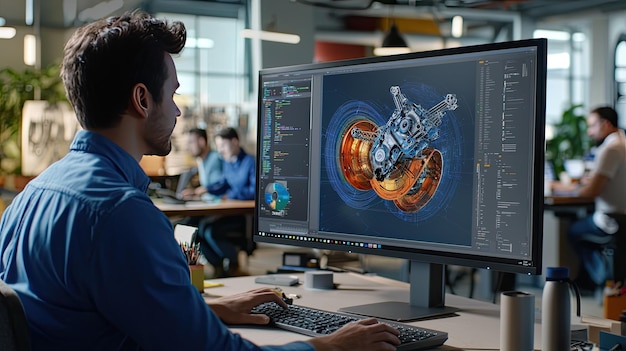
Engineering companies today must deliver products that meet strict performance and safety standards while staying within budget and timeline limits. This challenge has increased the demand for digital simulation tools that can predict real-world behavior before manufacturing begins. One of the most effective approaches is product optimization, which uses advanced CFD techniques to analyze airflow, heat transfer, and fluid behavior. CFD modeling services help engineers refine designs, reduce errors, and achieve better results through accurate virtual testing.
A conversational look at CFD Modeling Services in everyday engineering
When teams ask how to test ideas faster and with fewer risks, CFD modeling services provide a practical answer. Instead of building several physical prototypes, engineers can explore design possibilities in a virtual environment and make confident decisions based on data.
What CFD Modeling Services Are
CFD, or Computational Fluid Dynamics, is a method that uses mathematical equations and numerical analysis to study fluid and thermal behavior. CFD modeling services apply this method using powerful software tools that simulate how air, liquids, and heat interact with a product’s surfaces.
These simulations show patterns such as pressure changes, temperature variations, and flow paths. Engineers can visually inspect problem areas and identify opportunities for improvement. This makes CFD a valuable tool for understanding complex systems that are difficult to measure using physical experiments alone.
Importance of CFD in Engineering Design
Modern engineering design depends on accuracy and efficiency. CFD modeling services support these goals by predicting how a product will behave under real operating conditions. This allows engineers to find weaknesses early, such as poor cooling, uneven pressure distribution, or unstable flow.
By fixing these issues during the design stage, companies can avoid costly redesigns later. CFD also enables engineers to test innovative ideas without the risk of building expensive prototypes for every concept.
Advantages of CFD Modeling Services
One of the main advantages of CFD modeling is cost reduction. Virtual testing reduces the need for repeated physical experiments, saving time and resources. Another benefit is faster development cycles. Engineers can analyze multiple design options quickly and select the most efficient solution.
CFD modeling services also improve product quality. Detailed simulation data helps engineers understand how small changes affect performance. This leads to better energy efficiency, longer product life, and improved reliability.
Applications Across Industries
CFD modeling services are widely used in many industries. Automotive companies use CFD to improve aerodynamics and cooling systems. Aerospace engineers rely on CFD to analyze airflow over wings and engines.
In electronics, CFD simulations help manage heat and prevent component failure. HVAC designers apply CFD to improve air circulation and indoor comfort. The energy sector uses CFD to study combustion, fuel efficiency, and emissions. These applications demonstrate the versatility and importance of CFD modeling in real-world engineering.
How CFD Helps with Design Validation
Design validation ensures that a product meets performance and safety requirements before manufacturing begins. CFD modeling services allow engineers to simulate real-life operating conditions, including high temperatures, pressure changes, and turbulent flow.
This process reduces uncertainty and builds confidence in the final design. It also supports regulatory compliance by providing documented evidence that the product has been tested through reliable engineering analysis.
Role of Skilled CFD Engineers
Accurate simulations require experienced professionals who understand both engineering principles and simulation software. Skilled CFD engineers know how to create realistic models, apply correct boundary conditions, and interpret results properly.
Working with CFD Modeling Services gives businesses access to experts who guide projects from concept to final validation. Their insights help turn simulation results into practical design improvements that support business goals.
Improving Collaboration with CFD
CFD modeling services also strengthen collaboration within organizations. Simulation results can be shared visually with designers, production teams, and managers. This makes complex technical information easier to understand for everyone involved.
With a shared view of performance data, teams can agree on design changes more quickly. This reduces misunderstandings and shortens the overall development timeline.
Choosing the Right CFD Service Provider
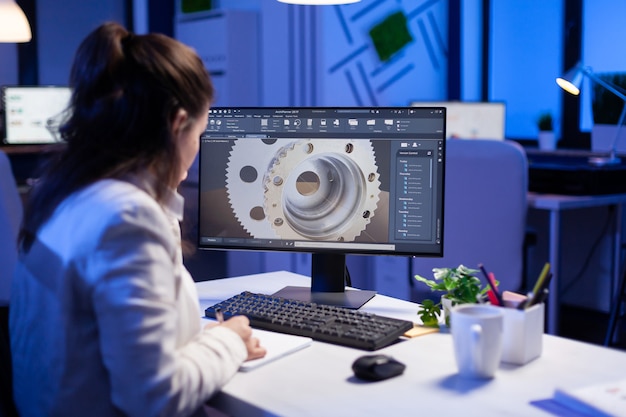
Selecting the right CFD service provider is essential for success. A reliable provider should have experience in different industries, access to advanced tools, and clear reporting methods.
The best CFD partners work closely with clients to understand project requirements and deliver actionable recommendations. This partnership ensures that simulations lead to real improvements in product design and performance.
Future Trends in CFD Modeling
CFD modeling services continue to evolve with new technology. Artificial intelligence and automation are improving simulation accuracy and speed. Cloud-based platforms allow engineers to run complex simulations faster and collaborate from different locations.
These advancements make CFD modeling an even more powerful tool for innovation and efficiency in product development.
Conclusion
CFD modeling services have become an essential part of modern engineering design. By simulating fluid flow and thermal behavior, engineers gain valuable insights that improve accuracy and reliability. From early concept testing to final validation, CFD modeling reduces costs, speeds up development, and supports innovation. Companies that use CFD modeling services gain a competitive advantage by delivering optimized and dependable products to the market.
Frequently Asked Questions
What is the purpose of CFD modeling services?
CFD modeling services are used to analyze fluid flow and heat transfer to improve product performance and design reliability before manufacturing.
How does CFD reduce development time?
CFD allows engineers to test multiple design options virtually, which shortens the need for repeated physical prototypes and speeds up decision-making.
Which industries use CFD modeling the most?
Industries such as automotive, aerospace, electronics, HVAC, and energy use CFD modeling extensively because their products depend on airflow, heat control, and fluid behavior.
