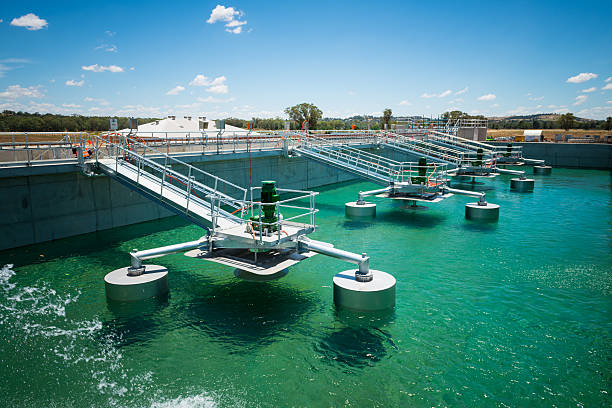
Quick Answer: Cooling tower water treatment controls the three things that destroy these systems: scale, corrosion, and microbial growth. It combines chemical dosing, filtration, and routine testing to keep recirculating water from damaging equipment or violating health and safety rules tied to Legionella.
A cooling tower is basically a giant evaporator running nonstop. Water cycles through, picks up heat, loses some of itself to evaporation, and concentrates everything left behind. That concentration is the root of almost every problem a cooling tower develops.
The Concentration Problem
Every gallon that evaporates leaves its dissolved minerals behind in the remaining water. Run a tower long enough without blowdown, and calcium, magnesium, and silica climb to levels that would never occur in the source water. That’s when scale starts forming on heat exchanger surfaces and fill media, and the system loses cooling capacity fast.
Blowdown, which bleeds off a portion of concentrated water and replaces it with fresh makeup, is the first line of defense. But blowdown alone doesn’t solve corrosion or biological growth. Those need their own treatment.
Chemical Treatment, Piece by Piece
Most cooling tower programs run several chemicals at once, each targeting a different failure mode.
Scale inhibitors keep calcium and other minerals in solution longer, even past the point where they’d normally precipitate. Corrosion inhibitors form a thin protective film on metal surfaces, slowing the electrochemical reactions that eat away at pipe walls and tube bundles. Biocides, usually a combination of oxidizing and non oxidizing types, knock down bacteria, algae, and the biofilm they build.
Here’s the part that surprises people: dosing isn’t a “set it and forget it” job. Water chemistry shifts with temperature, makeup water quality, and even how hard the system is running that week. A tower humming along fine in April can develop a biofilm problem by July once temperatures climb and bacteria find their stride.
Monitoring Is Where Programs Succeed or Fail
Testing conductivity, pH, biocide residual, and corrosion rates on a set schedule is what separates a program that works from one that just looks good on paper. Conductivity tells you how concentrated the water has gotten. pH drift signals a chemical balance problem before it shows up as scale or corrosion damage. Biocide residual testing confirms the dose actually reached an effective level, not just that it was added.
Legionella adds another layer most facilities can’t ignore. ASHRAE 188 and related state health codes increasingly require documented monitoring plans for cooling towers, and a positive Legionella test can shut a system down until it’s remediated. Skipping routine testing here isn’t just a maintenance risk. It’s a legal one too.
Building a Program That Actually Holds Up
A solid cooling tower water treatment plan looks at the whole system, not just the chemical feed pumps. Makeup water quality, tower design, system volume, heat load, and even local climate all shape what the right chemical mix and dosing schedule should be.
This is usually where a dedicated cooling tower water treatment provider earns its fee. Working with a team that tracks trends across multiple readings, rather than reacting to a single bad test, catches drift before it turns into a fouled exchanger or a failed compliance audit. We’ve seen towers go from chronic scaling problems to clean operation within a single season once the program got matched to the actual water chemistry instead of a generic dosing chart.
Should every tower run the same chemical program? Not even close. A tower running near a coastal facility with high chloride makeup water needs a different corrosion strategy than one running on soft well water inland. The fundamentals stay the same. The specifics don’t.
What Happens When the Program Gets Skipped
A tower that goes a single quarter without proper biocide dosing doesn’t always show visible problems right away. The fill media can be quietly losing efficiency while the chiller plant compensates by running harder, and energy bills climb without anyone connecting the dots back to water chemistry.
Eventually something gives. Maybe it’s a clogged strainer that trips an alarm at 3 a.m. Maybe it’s a Legionella sample that comes back positive during a routine health inspection. Either way, the fix at that point costs more, takes longer, and usually involves downtime that a steady treatment program would have avoided entirely.
Plant teams that have been burned once tend to take monitoring a lot more seriously the second time around. The trick is building that discipline in before the first failure, not after it.
Frequently Asked Questions
Q: What does cooling tower water treatment actually prevent? A: It prevents scale buildup, corrosion damage, and microbial growth, including Legionella, inside the recirculating water system.
Q: How often should a cooling tower be tested? A: Most programs test conductivity and biocide levels weekly, with a full water analysis monthly or quarterly depending on system risk.
Q: What is blowdown and why does it matter? A: Blowdown removes a portion of concentrated water from the system, preventing minerals from building up to scale forming levels.
Q: Is Legionella testing required for cooling towers? A: Many states and ASHRAE 188 guidelines now require documented monitoring plans, especially for towers in healthcare or public facing buildings.
Q: Can a small cooling tower skip chemical treatment? A: Even small towers concentrate minerals and grow biofilm over time. Skipping treatment usually just delays the problem, not prevents it.
A cooling tower that’s treated well almost disappears from the maintenance conversation. It’s the ones running on guesswork that keep showing up on the repair list.
