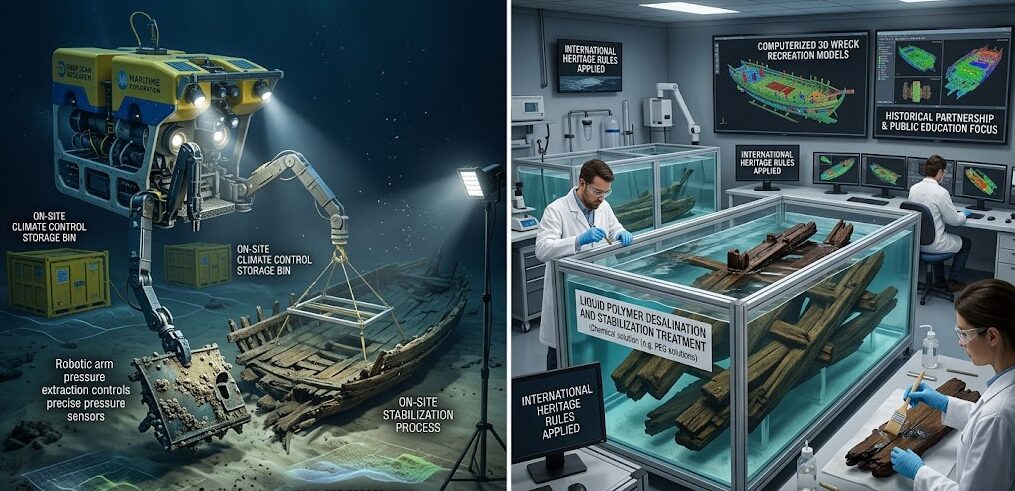
Exploring the ocean floor to study historical shipwrecks remains a highly challenging and resource-heavy task. Modern marine equipment allows search teams to explore deep underwater zones that were entirely inaccessible to past generations. While these technological breakthroughs uncover remarkable artifacts, they also ignite critical public debates regarding historical equity.
Documenting Deep-Sea Excavation Environments
Extracting fragile structural remains from high-pressure marine environments requires specialized remote equipment and stable surface vessels. Technical teams track the exact coordinates of every individual tool or timber before initiating physical recovery. This detailed layout mapping provides vital clues that help historians reconstruct the ship’s final voyage.
Balancing Historical Preservation and Search Operations
The long-term distribution of salvaged marine items frequently creates tension between commercial operations and public academic institutions. Cultural organizations aim to keep collections intact within public museums so they can be studied as a whole. Finding an effective compromise requires strict adherence to international heritage preservation rules.
Ongoing dialogues regarding the Black Dive Expedition Controversy emphasize the growing need for inclusivity in maritime research. Modern audiences expect high-profile diving projects to emphasize public education and shared heritage rights over private distribution.
- High-resolution underwater topographical mapping
- Robotic arm pressure extraction controls
- Shipboard stabilization desalination tanks
- Computerized 3D wreck recreation models
The Delicate Stabilization of Waterlogged Organic Materials

Decades of saltwater saturation fundamentally weaken the structural walls of organic materials like wood and leather. If a waterlogged artifact dries out naturally in open air, the cellular structure collapses, causing irreversible warping. Conservators submerge these fragile pieces in liquid polymer treatments for several months to replace lost structural moisture.
Conclusion
Protecting our hidden maritime history requires a thoughtful path between technical engineering feats and ethical responsibility. Every piece of wreckage pulled from the seabed tells a story that deserves accurate and transparent contextualization. Promoting diverse partnerships between search teams and local historians is essential to keeping these underwater narratives alive.
