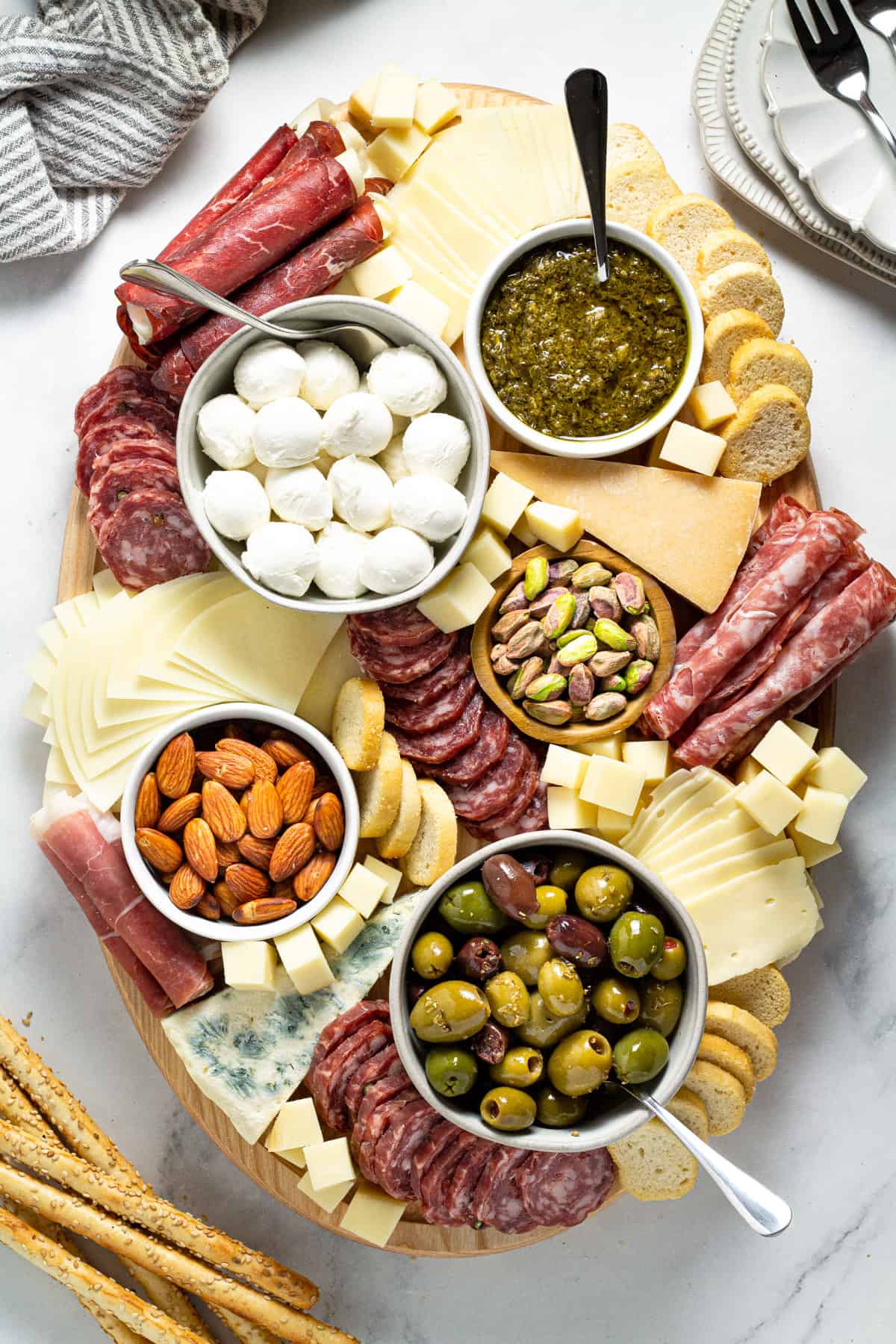
Quick Answer: A meat and cheese board is a curated arrangement of cured meats, artisan cheeses, and complementary accompaniments displayed together on a board for shared grazing. The best boards balance flavor contrast across salty, creamy, tangy, and rich profiles, and are built with a ratio of roughly 2 ounces of meat and 2 to 3 ounces of cheese per person for appetizer portions. Accompaniments including crackers, jams, olives, nuts, and fresh fruit complete the eating experience.
A meat and cheese board done well is one of the most social objects in entertaining. It sits in the middle of a table and draws people together. Conversations start over it. Guests discover combinations they have never tried. Someone inevitably becomes the expert and starts recommending pairings to people nearby. Done poorly, it is an overlooked afterthought with a half-eaten block of cheddar and a sleeve of crackers.
The difference between those two outcomes is almost entirely intentionality. The ingredients, the pairings, the arrangement, and the quantity all determine whether a meat and cheese board becomes the remembered centerpiece of an event or background decor that guests visit once.
This guide covers what actually belongs on a board, in what quantities, and why the professional version looks and tastes so different from the assembled-at-home version.
The Core Components: What Goes on a Meat and Cheese Board
Cured and Preserved Meats
The meat selection sets the flavor range of the board. Three to four varieties at any event creates enough diversity without overwhelming guests. The goal is contrast: something mild, something bold, something with interesting texture.
Prosciutto di Parma is the baseline. Thin, delicate, salt-forward, and fat-marbled, it pairs with almost everything on the board and is universally recognized. Fold it loosely rather than laying it flat; the visual dimensionality improves the board’s appearance and makes it easier for guests to pick up.
Soppressata is a dry Italian salami with fennel and mild spice. It holds its shape well, has a firm texture that contrasts prosciutto’s delicacy, and works with both sharp and mild cheeses. Sliced thin and fanned or stacked in small groups, it creates visual structure in the meat section.
Spicy coppa or calabrese provides the heat note that many guests specifically seek out. One spicier option on the board gives the flavor range a defined edge without dominating the overall profile.
Mortadella with pistachios is an underused option that reads as visually impressive and tastes unexpected. Its pale color with green pistachio flecks photographs beautifully and its mild, slightly sweet flavor works for guests who find heavy cured meats too intense.
Artisan Cheeses
The standard professional guidance is three to four cheeses covering distinct texture and flavor profiles: one soft, one semi-firm, one aged hard, and optionally one bold or blue.
Brie or camembert as the soft option is almost always the first cheese guests reach for. Its mild, creamy, buttery flavor is accessible and pairs with nearly everything. A full wheel with the top cut creates a visual moment and encourages guests to scoop rather than slice.
Manchego from Spain is the most versatile semi-firm option on a board. Aged three to six months, it has a nutty, slightly grassy flavor that works with fruit jam, honey, prosciutto, and olives equally well. It is also firm enough to pre-slice without falling apart, which matters for board assembly.
Aged parmesan or aged cheddar provides the sharp, crystalline texture of a properly aged hard cheese. Breaking it into irregular chunks rather than slicing it creates a more rustic, abundant look and the varying chunk sizes give guests portion control.
Gorgonzola dolce or bleu d’Auvergne as the optional bold option gives guests a strong flavor anchor. Not everyone will reach for it, but its presence on the board elevates the overall curation and gives blue cheese enthusiasts a reason to linger.
Accompaniments: The Detail That Separates a Board from a Platter
This is where most home boards fall short and most professional boards excel. Accompaniments are not filler; they are the bridges that make meat and cheese combinations work.
Fig jam or sour cherry preserves provide the sweet contrast that makes salty meat and sharp cheese combinations more dynamic. A small jar of fig jam next to manchego and prosciutto is a classic pairing point that most guests discover and return to.
Whole grain mustard offers pungent, acidic contrast particularly effective with charcuterie meats and aged cheeses. One small dish of mustard on a board used consistently by guests signals that it is the right call.
Cornichons and olives add brine and acidity that clean the palate between richer combinations. Castelvetrano olives are the most visually striking option, with their bright green color and mild buttery flavor that does not overpower neighboring items.
Crackers and bread need variety. One cracker type is not enough. A plain water cracker, a seeded crispbread, and a slice of sliced baguette give guests a substrate range. The bread serves the softer cheeses; the crisps serve the firmer ones.
Nuts and honey round the board into a complete eating experience. Marcona almonds have a quality that makes them feel more appropriate than standard almonds on a premium board. A small honeycomb piece or a honey dipper over a small jar is one of the more impactful single visual additions to any charcuterie setup.
Ratios and Quantities: How Much to Buy
Underbuilding a board is the most common mistake. A sparse board looks ungenerous regardless of ingredient quality.
Appetizer board for 8 to 10 people: 2 oz of each meat variety (6 to 8 oz total), 3 oz of each cheese variety (9 to 12 oz total), plus accompaniments. This assumes other food is being served.
Board as a main grazing station for 8 to 10 people: Double the quantities. A grazing board intended to replace a sit-down appetizer course needs substantially more protein to satisfy.
The abundance principle: Professional boards look abundant even before anyone touches them. The visual impression of generosity is part of the experience. If the board looks exactly right with nothing taken from it, it was probably slightly underfilled. Add 20% more than your estimate suggests and distribute the excess across the cheese portions.
How Professional Boards Differ from Home-Built Boards
There are a few specific things that distinguish professionally arranged charcuterie boards from home attempts, and they are learnable rather than innate.
Ingredient sourcing: Professional charcuterie uses imported DOP-certified meats and artisan cheeses rather than grocery store deli versions. The quality difference is significant. Prosciutto di Parma sliced fresh from a leg tastes entirely different from pre-packaged prosciutto.
Arrangement density: Professional boards have no visible board surface. Every inch is covered, whether with food, herbs, or decorative elements. The fullness is deliberate and takes more product than most people budget for.
Folding and fanning technique: Prosciutto folded into loose rosettes, salami fanned in overlapping slices, and cheese broken or cut into different shapes all add visual dimension that flat-laid ingredients cannot match.
Color intentionality: The dark red of salami next to the pale ivory of brie next to the deep green of castelvetrano olives is not accidental. Professional boards are built around color blocking the same way a florist builds an arrangement.
Meat and Cheese Boards for Phoenix Metro Events
In the Phoenix Metro and Chandler area, charcuterie boards for outdoor events need specific consideration. Temperature affects both the safety and quality of the food. Soft cheeses like brie should not sit in direct sunlight above 90 degrees Fahrenheit for more than 30 minutes. Cured meats hold better but develop an unpleasant sheen in intense heat.
The practical approach for Arizona events: set the board out shortly before guests arrive, keep it in shade, and plan for it to be largely consumed within an hour. If the event is outdoors in summer, a smaller board replenished from refrigerated reserve is better than a large board set out for two hours.
For indoor events, catered office functions, corporate gatherings, and home celebrations in Chandler, Gilbert, and the broader Phoenix Metro, professionally built boards eliminate all of these logistical concerns since experienced caterers account for local climate conditions in how they build, transport, and time their boards.
Frequently Asked Questions
Q: What is a meat and cheese board?
A meat and cheese board is a curated arrangement of cured meats, artisan cheeses, and accompaniments displayed together on a shared surface for communal grazing. It is typically served as an appetizer, party centerpiece, or gift presentation.
Q: How many people does a charcuterie board serve?
As an appetizer, one pound of combined meat and cheese serves approximately four to five people. As a main grazing station, the same quantity serves two to three. Professional board builders typically size boards by the guest count, building in abundance so the board still looks full midway through the event.
Q: What cheese goes on a charcuterie board?
A well-built charcuterie board includes cheeses across texture and flavor categories: one soft and mild (brie, camembert), one semi-firm and nutty (manchego, gruyere), and one aged hard (parmesan, aged cheddar). A fourth blue or bold cheese rounds the selection for guests who want a stronger flavor option.
Q: What is the difference between a charcuterie board and a grazing table?
A charcuterie board is a single, portable board arrangement typically serving one table or group. A grazing table is a large-scale, styled food display covering a full table surface, designed for events with 20 or more guests where continuous replenishment and dramatic visual impact are part of the experience.
Q: Can I order a meat and cheese board for delivery in Chandler?
Yes. Specialty charcuterie services in Chandler and the broader Phoenix Metro offer boards in multiple sizes for delivery or pickup. Ordering from a professional ensures properly sourced ingredients, food-safe transport, and board quality that holds for the duration of the event.
